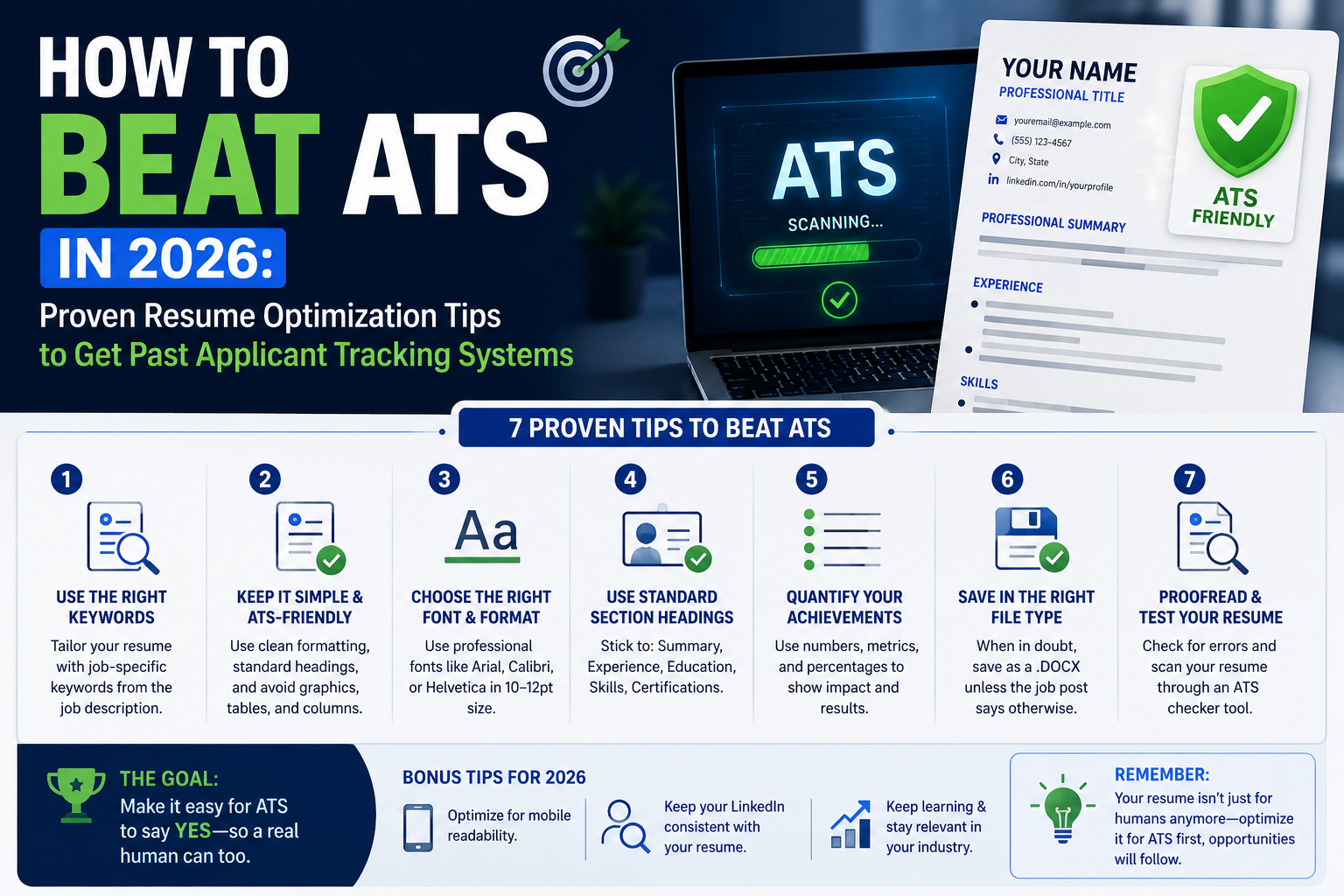
How to Beat ATS in 2026: Proven Resume Optimization Tips to Get Past Applicant Tracking Systems
The Brutal Reality of Job Hunting in 2026
Picture this: You've polished your resume to a mirror shine, poured your career story into every bullet point, and hit 'apply' on what feels like the perfect job. Days turn into weeks. Crickets. No callbacks, no interviews, just silence echoing through your inbox. Sound familiar? If you're a job seeker, tech professional switching lanes, recent grad stepping into the arena, or a laid-off worker rebuilding momentum, this is the 2026 job market gauntlet.
Over 99% of Fortune 500 companies—and countless others—use Applicant Tracking Systems (ATS). These aren't sci-fi robots rejecting your dreams; they're databases designed to filter mountains of applications. Recruiters post a job; ATS scans resumes, ranks them by relevance, and spits out a shortlist. Your resume? It might never reach human eyes without cracking this code.
But here's the good news: how to beat ATS isn't rocket science. It's strategy, precision, and a dash of tech savvy. This guide arms you with proven ATS resume tips for 2026, drawing from real-world evolutions in parsing tech. We'll boost your visibility, improve your odds, and get you past those digital gatekeepers.
What's New in ATS for 2026: AI Gets Smarter, Not Stricter
Gone are the days of rigid keyword-stuffing games. By 2026, ATS platforms like Workday, iCIMS, and Taleo have leveled up with AI and natural language processing (NLP). They don't just hunt exact phrases anymore—they grasp context, semantics, and intent.
Semantic Search Takes Center Stage
Imagine an ATS reading your resume like a savvy recruiter: 'Led a team to boost revenue 30%' scores high for 'sales leadership' even if the job says 'drove growth initiatives.' This shift to semantic relevance means synonyms, related skills, and narrative flow matter. Tools now analyze sentence structure, quantify achievements, and even detect skill clusters—like pairing 'Python' with 'machine learning' for data roles.
Multimodal Parsing and Bias Checks
2026 ATS handles PDFs, Word docs, and even scans handwritten notes (though stick to digital natives). They're baked with DEI algorithms to flag biased language, prioritizing inclusive phrasing. For tech pros and career switchers, this opens doors: transferable skills from adjacent fields get weighted higher if framed right.
The takeaway? Resume optimization now rewards authenticity over tricks. Tailor smartly, and your odds skyrocket.
Busting Common ATS Myths: No More Excuses
Myths persist like urban legends in job forums. Let's torch them with facts for your ATS resume tips 2026 arsenal.
- Myth: Fancy formatting kills your chances. Truth: Modern ATS parses bold, italics, even some colors—as long as structure is simple. Skip headers/footers and complex layouts.
- Myth: PDF is dead. Truth: Most 2026 systems love PDFs for fidelity, but .docx wins for editable parsing. Test both.
- Myth: Acronyms confuse ATS. Truth: Spell out first ('Search Engine Optimization (SEO)'), then abbreviate. AI handles context now.
- Myth: One resume fits all. Truth: Generic blasts tank. Tailoring is non-negotiable.
Debunking myths frees you to focus on what works: clean, keyword-smart content that sings to both machines and humans.
Core Strategies to Get Past Applicant Tracking Systems
1. Master Keyword Alignment: Balance Without Stuffing
Job descriptions (JDs) are goldmines. Extract 10-15 key terms—skills, tools, metrics—from the posting. Weave them naturally: mirror phrasing like 'Agile methodology' if listed. For recent grads, highlight projects; laid-off pros, emphasize recent wins.
Pro tip: Use tools like Google Keyword Planner or JD analyzers for semantic matches. Aim for 80-90% alignment without repetition.
2. Bulletproof Formatting: Simple Wins Every Time
ATS chokes on visuals. Stick to:
- Fonts: Arial, Calibri, Times New Roman (10-12pt).
- No tables, images, charts, or text boxes—ATS skips them.
- Standard sections: Contact, Summary, Experience, Skills, Education.
- Left-align everything; one column only.
3. Tailor Ruthlessly: Why Generic Resumes Fail
A one-size-fits-all resume scores 20-30% on average. Customized? Up to 75% match rates. For career switchers, reframe experience: 'Marketing automation → CRM implementation.'
Story time: A tech PM applying to AI roles swapped 'project delivery' for 'deployed ML models, reducing latency 40%.' Boom—interviews flowed.
The 'Fix It' Approach: Enter SignalResume
Manual tweaks work, but they're time sinks. Enter SignalResume, the 2026 game-changer for how to beat ATS. Unlike scorers that just flag issues, SignalResume analyzes your resume against any JD, then rewrites bullets for semantic punch, keyword harmony, and human appeal.
Upload resume + JD. It scans for gaps, suggests quantifiable tweaks ('Managed team' → 'Led 12-person dev team to ship MVP in 3 months'), and outputs an ATS-optimized version. Tech pros love its skill-mapping; grads get project boosts. Best? It improves match scores by 40-60% on average, per user benchmarks.
No more guesswork—this is resume optimization on steroids, tailored for busy hunters like you.
Step-by-Step Workflow: Optimize Your Resume Today
- Paste the JD. Copy the full job description into SignalResume or a free analyzer.
- Extract Keywords. Note top skills (e.g., 'React, AWS, SQL'). Categorize: hard/soft, tools/metrics.
- Audit Your Resume. Run through SignalResume for a score. Check parsing in free ATS simulators like Jobscan.
- Rewrite Summary. 3-5 lines mirroring JD: 'Results-driven full-stack developer with 5+ years in React/Node.js, seeking to drive scalable solutions at [Company].'
- Revamp Bullets. Action verb + task + result. Quantify: 'Increased user engagement 25% via A/B testing.'
- Skills Section Magic. List 12-15, exact JD matches first. Include variations (e.g., 'Python, scripting').
- Test & Export. PDF and DOCX. Apply, track, iterate.
- Bonus: LinkedIn Sync. Mirror optimizations there for recruiter searches.
Repeat per application. For volume applicants (laid-off pros), batch-process with SignalResume.
Advanced Tweaks for Tech and Switchers
- GitHub/Portfolio links: Hyperlink plainly.
- Open-source contribs: Frame as 'Contributed to Kubernetes, merging 10 PRs.'
- Career gaps: Bridge with 'Freelance/Up-skilling in [skill] during transition.'
Your Next Move: Scan Free and Surge Ahead
Beating ATS in 2026 isn't luck—it's execution. You've got the blueprint: semantic keywords, clean formats, ruthless tailoring, powered by tools like SignalResume. Job markets reward the prepared. Don't let a parse error sideline you.
Ready to get past applicant tracking systems? Grab your free resume scan at SignalResume today. Upload, analyze, optimize—and watch opportunities unlock. Your breakthrough interview awaits.
In a sea of applications, be the one that surfaces first.